When I returned to using my Substack account this week I was prevented from logging in unless I proved I am aged over 16.
While I was away the Australian government appointed an E-Karen (Julie Inman Grant). She is causing mayhem for the adults in the room and I am not alone.
Many writers and readers have found themselves effectively shut out of platforms such as Substack, Patreon, and others, unless they agree to age-verification checks.
The Online Safety Act, supported by all major political parties and cheered on by much of the deadwood media and its digital offsprings, has achieved little beyond forcing adults to jump through hoops to retain access to services they already had, while many of the kids it was supposed to protect continue as before.
I disliked the online safety bill when it was first floated by the Albanese government. The unintended consequences were obvious from the outset. Common-sense objections were brushed aside in favour of an easy headline swallowed wholesale by those who can’t see further than the end of their nose.
Many thinking people saw this move not primarily as a measure to protect children, but as a mechanism that makes it easier for government to identify who is saying what online, even when that speech is lawful.
Under the Act, Australia’s eKaren can compel platforms to provide identifying information about specific users where it is deemed relevant to enforcement. Well, that’s what they say.
It seems to me that government had no problem identifying those questioning the covid-era lockdowns? Post anything untoward, anything that didn’t support the narrative, and the old bill would be on your doorstep quick-smart, pepper spray in one hand, a stick in the other and pocket full of allegations – enough to arrest you in front of your kids and neighbours. For what? Words!
This week, when I attempted to return to my Substack account – where I infrequently write about politics and world affairs for a small (but growing) audience – I was asked to verify my age. I declined out of principle, as have many hundreds of others, both publishers and readers. The impact of this law on Substack and other platforms is difficult to quantify, but it cannot be trivial.
…how did a law supposedly designed to protect children come to cover a platform overwhelmingly used by adults…
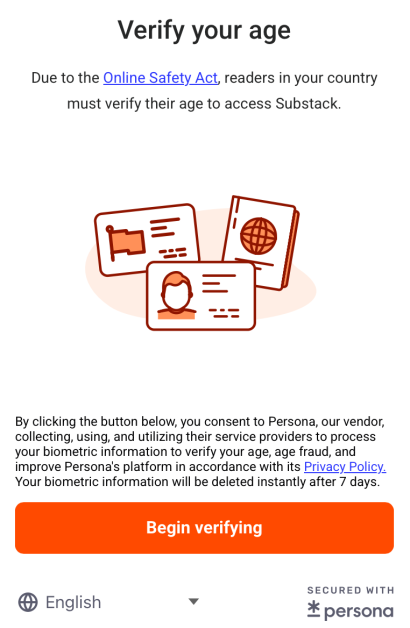
To continue using Substack, I was directed to complete age verification via a company called Persona. The process involved either uploading a photo or video of my face, no doubt for an AI system to estimate my age, or by submitting government-issued identification – presumably a driver licence or passport. Persona, a private company valued at around USD$2bn, received neither from me. The same company is also used by the Australian government. Make of that what you will.
But how did a law supposedly designed to protect children come to cover a platform overwhelmingly used by adults, with no reputation whatsoever for attracting under-16s? The likely answer is that Substack is simply protecting itself from the risk of substantial fines under the act. Yet publishers such as The Age et al continue without age verification…Why is mainstream media so special?
What can be done? Well, at a minimum, the federal government should recognise reality and grant Substack and Patreon an exemption from age-verification requirements.
- The largest cohort of Substack users is aged 25-34
- Significant numbers fall within the 25-44 age range
- One analysis found approximately 31.7 per cent of visitors aged 25-34 and 19.2 per cent aged 35-44
As for Substack, it does not appear to be an enthusiastic supporter of the Online Safety Act. On its website, the company states: “At Substack, we believe that a free press is essential for a free society, and that in the modern world, that means a free internet.
“Around the world, we’re seeing an increase in laws aimed at reducing harm from online speech by requiring platforms to block, label, or collect identification before people can view certain content.
…these laws are not necessarily effective at achieving their stated aims…
“Though they are often well-intentioned, these laws are not necessarily effective at achieving their stated aims, and they come with real costs to free expression.
“They also place significant power in the hands of regulators and political leaders who help determine what speech is allowed – even for adults – setting a precedent for future restrictions.”
It’s a real concern. Once identity checks become normalised, they expand. And once the machinery exists, it is rarely, if ever, dismantled.
For now, I can’t bring myself to publish on a platform I previously enjoyed using, unless I surrender personal data to a third party I do not trust – under a law I believe is deeply flawed.
I won’t be missed. But I miss having Substack as a platform to share my thoughts and opinions.